When you look at Hisense’s 2025 TV lineup, there is a broad spectrum: from premium, cutting-edge displays to more affordable QLED Fire and smart LED models. At the top end, you have flagships like the Hisense 116UX (RGB MiniLED, huge sizes, extreme brightness) and the ULED “U-Series” like U9Q, U8Q, U7Q / U7Q Pro, U6Q, and above those, the UX models. These offer top performance in HDR, gaming (with very high refresh rates), superior brightness, advanced local dimming, etc. Below or adjacent to the E6 are the QLED tiers such as the E7Q / E7Q Pro, E8Q, and the more budget-friendly QD6 / QD7 series.
From other brands, comparable mid-to-upper mid range models might include Samsung’s QLED offerings (e.g. Q60/Q70 series), LG’s mid QLEDs or OLEDs (depending on pricing), TCL’s QM6 / QM8 series etc. These compete on color, HDR performance, refresh rates (especially for gaming), and smart-platform features.
Hisense E6 therefore occupies a mid-to-entry part of the QLED / Fire TV family: more capable than very entry-level sets, but not matching the premium ULED / MiniLED “U-Series” or the UX flagship models. What you get is good color and smart features, with some compromises appropriate for its positioning.
Hisense E6 Short Review
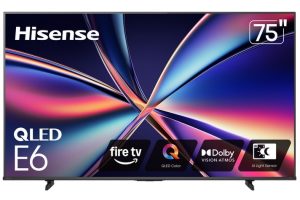
The Hisense E6 (2025) delivers a surprisingly strong package for its price point. Picture quality is good: the QLED panel gives vibrant color, and HDR support (including formats like Dolby Vision and HDR10+ Adaptive) helps bring out richer highlights and contrast in movies and streaming. For everyday TV watching, streaming, and movies in moderate lighting, it performs quite well—colors look lively and the UI is snappy.
The smart features are also a plus: Fire TV is mature, provides a wide app ecosystem, voice remote with Alexa is helpful, and features like the AI Light Sensor are thoughtful touches (adjusting brightness based on room light helps comfort and energy usage). Game Mode Plus adds in lower latency and improves responsiveness, which is helpful for casual gaming.
However, the trade-offs are clear: motion for fast-paced content (sports, racing, action video games) isn’t as smooth as with higher refresh-rate TVs (120 Hz, 144 Hz, etc.). Brightness and contrast are decent but won’t match what you see in the premium MiniLED or OLED tiers—so in very bright rooms or with strong glare, the performance is more limited. Also, viewing angles and cinematic immersion (like deep blacks, superb local dimming) are going to lag behind the more advanced models in the U series or OLED from other brands.
Overall, for its target audience—someone wanting good visuals, modern smart features, and a large screen without paying premium prices—the E6 is a solid, pragmatic choice.
| Hisense E6 Prices | |
| 100-Inch (100E6QF) | Check Today’s Price (Amazon.com)… |
| 85-Inch (85E6QF) | Check Today’s Price (Amazon.com)… |
| 75-Inch (75E6QF) | Check Today’s Price (Amazon.com)… |
| 65-Inch (65E6QF) | Check Today’s Price (Amazon.com)… |
| 55-Inch (55E6QF) | Check Today’s Price (Amazon.com)… |
| 50-Inch (50E6QF) | Check Today’s Price (Amazon.com)… |
| 43-Inch (43E6QF) | Check Today’s Price (Amazon.com)… |
Hisense E6 Key Specs
Here are the key specs of Hisense E6 (model E6QF) from Hisense’s 2025 lineup:
| Specification | Detail |
| Display Type | QLED (Wide Color Gamut) |
| Resolution | 4K UHD (3840 × 2160) |
| Refresh Rate (Native) | 60 Hz (most sizes) |
| Motion Rate / Processing | Motion Rate 120 / includes “Game Mode Plus” |
| HDR Support | Dolby Vision, HDR10+ Adaptive |
| Audio / Sound | Built-in speakers; Dolby Atmos support; voice remote with Alexa; Fire TV OS |
| Smart OS / Features | Fire TV built-in; AI Light Sensor; wide streaming app support; voice control |
| Sizes Available | 43″, 50″, 55″, 65″, 75″, 85″, 100″ |
| Connectivity | 4/3 HDMI, USB, Wi-Fi, Bluetooth |
| Price |
Hisense E6 Pros and Cons
Here’s a balanced view of what the E6 does well — and where it falls short.
Pros
- Strong color performance for its class thanks to QLED; HDR formats give added punch.
- Good smart platform with Fire TV: lots of content, voice control, familiar interface.
- Broad size options: gives you flexibility whether you want a modest screen or a large display.
- Value: compared to ULEDs or premium OLEDs, you sacrifice some features but retain a solid core experience.
- Features like Game Mode Plus, AI Light Sensor help bridge the gap toward higher tier sets for those not needing all-premium specs.
Cons
- Native refresh rate is limited (60 Hz) on most sizes — so for very fast action, gaming or sports, there will be visible blur or less smooth motion compared to 120/144/165 Hz models (like U7Q, U8Q).
- Brightness is modest vs premium sets; in bright rooms may struggle with glare or washed-out HDR.
- Less advanced local dimming (or fewer dimming zones) than in ULED / MiniLED models — so contrast isn’t as strong.
- Viewing angles, black levels, and overall “premium” experiences (e.g. more refined audio, bezel, motion smoothing) are areas you’ll notice the gap if you’ve used higher-end TVs.
- For power users (true gamers, home theater purists) there are trade-offs you’ll feel: fewer HDMI 2.1 full-speed ports maybe, less headroom in performance.
Is Hisense E6 a Good Choice for You?
Putting this all together:
If your priorities are good picture quality, modern smart features, and a large screen, but you’re okay to trade off the absolute highest brightness, refresh rate, or contrast, then yes — the Hisense E6 is probably a good match. It’s especially suited to:
- Watching streaming content, TV series, movies in low-to-moderate ambient light.
- Casual gaming, especially if not playing very high-fps competitive titles.
- Getting a grand screen while staying within a mid-price budget.
On the other hand, if any of these are non-negotiable:
- High refresh rates (120Hz+ or 144Hz+) for smoother sports and fast games;
- Very high brightness (for bright rooms, glare, daylight viewing);
- Deep blacks, top contrast, wide viewing angles (OLED or high-end MiniLEDs do better here);
- Premium audio or superior build quality —
…then you might want to look into slightly higher models in Hisense’s lineup (U6Q, U7Q / U7Q Pro, U8Q, U9Q or the UX series) or compare similarly priced sets from Samsung, LG, TCL, Sony, etc.
| Hisense E6 Prices | |
| 100-Inch (100E6QF) | Check Today’s Price (Amazon.com)… |
| 85-Inch (85E6QF) | Check Today’s Price (Amazon.com)… |
| 75-Inch (75E6QF) | Check Today’s Price (Amazon.com)… |
| 65-Inch (65E6QF) | Check Today’s Price (Amazon.com)… |
| 55-Inch (55E6QF) | Check Today’s Price (Amazon.com)… |
| 50-Inch (50E6QF) | Check Today’s Price (Amazon.com)… |
| 43-Inch (43E6QF) | Check Today’s Price (Amazon.com)… |